

Table of contents
If your income and concessional super contributions add up to more than $250,000 for the financial year, you may receive a Division 293 assessment. The tax adds 15% to some or all of your concessional contributions, on top of the 15% contributions tax already paid through your super fund. That can bring the total tax on the affected amount to 30%. Salary sacrificing may still be worthwhile at that rate, but it depends on your contribution cap, cash flow and broader tax position.
Last verified against ATO guidance: September, 2026
What Is Division 293 Tax?
Division 293 is an additional 15% tax on concessional super contributions for high-income earners. It exists to trim the tax break higher earners get from putting money into super. Without it, someone on the top marginal rate would drop 32 cents in the dollar every time they contributed. With it, the gap narrows.
Two things get measured together: your Division 293 income and your Division 293 super contributions. If the total crosses $250,000, the tax kicks in on the concessional contributions inside that excess. The 15% applies on top of the 15% contributions tax your fund already pays, giving you a 30% effective rate on the affected contributions.
Who Pays Division 293 Tax?
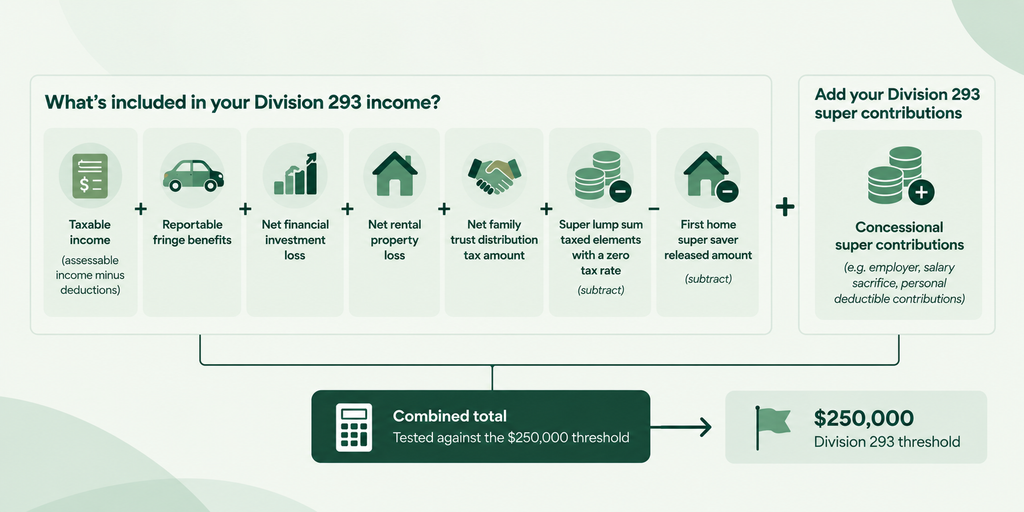
This is where most people get it wrong. Division 293 income isn't just your salary. The ATO stacks several things together to work out whether you're over the threshold.
The income test includes:
- Taxable income (assessable income minus deductions)
- Total reportable fringe benefits amounts
- Net financial investment loss
- Net rental property loss
- Net amount on which family trust distribution tax has been paid
- Super lump sum taxed elements with a zero tax rate (this component is subtracted)
- Assessable first home super saver released amount (also subtracted)
Then your Division 293 super contributions (essentially your concessional contributions for the year) get added on top. That combined figure is what's tested against $250,000.
So a $220,000 salary earner with a negatively geared property and reportable fringe benefits can absolutely land inside Division 293 territory, even though the payslip alone doesn't show it.
The $250,000 Threshold and 15% Rate
The Division 293 threshold has been $250,000 since the 2017–18 financial year. From 2012–13 to 2016–17 it was $300,000. The rate is 15%, applied to whichever is lower: the amount you're over the threshold by, or your total concessional contributions for the year.
That "lesser of" rule matters. It stops the tax hitting money that had nothing to do with pushing you over.
How Division 293 Tax Is Calculated
Example 1, based on an ATO scenario: Division 293 income of $240,000 and concessional contributions of $15,000 produce a combined total of $255,000. Only $5,000 sits above the threshold, so the additional tax applies to that amount. At 15%, the liability comes to $750.
Example 2, covering the 2026–27 concessional cap: A person with Division 293 income of $280,000 makes $32,500 in concessional contributions, bringing the combined figure to $312,500. The excess over the threshold is $62,500, so the full $32,500 is subject to Division 293 tax. At 15%, the liability is $4,875.
| Scenario | Div 293 income | Concessional contributions | Excess over $250K | Taxable contributions | Div 293 tax |
| Example 1 | $240,000 | $15,000 | $5,000 | $5,000 | $750 |
| Example 2 | $280,000 | $32,500 | $62,500 | $32,500 | $4,875 |
How the Division 293 Assessment Works
The ATO doesn't send the bill straight after your tax return goes in. It waits until your super fund has reported contribution data and matches it against your income tax assessment. The Division 293 notice then lands through myGov or the post, often six to twelve months after the financial year ends.
The delay can catch people off guard. By the time the notice arrives, the tax refund may be gone and last year’s salary sacrifice arrangement may no longer be top of mind. The assessment is issued only after the ATO receives and matches the required income and contribution data.
Paying Division 293: Release Authority or Out of Pocket?
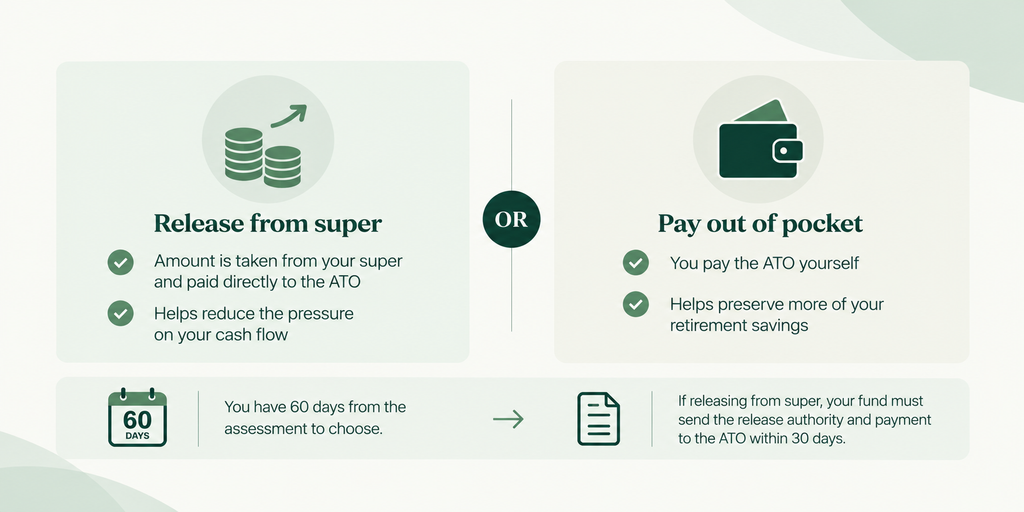
Once the assessment arrives, you have up to 60 days to elect to release the money from your super fund. If you go that route, an APRA-regulated fund must complete the release authority statement and send both the statement and payment to the ATO within 30 days of receiving a valid authority. SMSF trustees managing the release handle the process directly through the fund.
You can pay the liability personally or elect to release money from super. Paying personally preserves more of your retirement savings, while releasing the amount from super reduces the immediate pressure on your cash flow. The better option depends on your available cash, retirement strategy and wider financial position, so it should be assessed individually.
Does Salary Sacrificing Still Make Sense After Division 293?
Division 293 does not necessarily affect every concessional dollar. The additional 15% applies to whichever is lower: your Division 293 super contributions or the amount by which your combined income and contributions exceed $250,000. If your Division 293 income already exceeds $250,000, all relevant contributions may be affected.
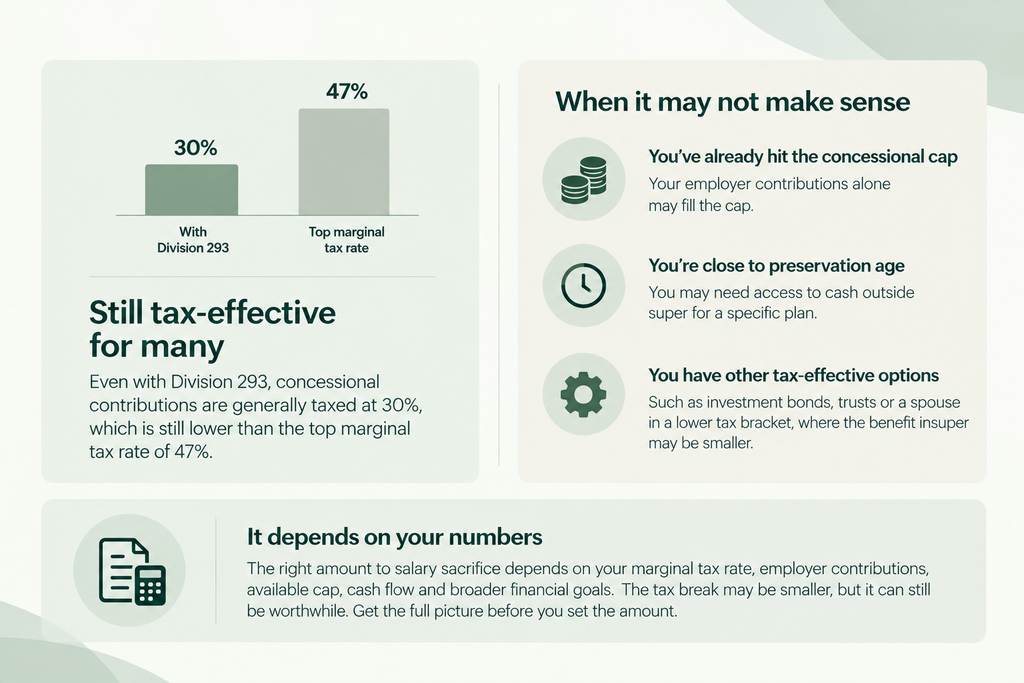
Thirty per cent still beats forty-seven per cent. For many high-income earners, salary sacrificing can remain tax-effective even after Division 293 applies. The result depends on your marginal tax rate, employer contributions, available cap, cash flow and wider financial position. The tax break is smaller than it used to be, but it's still a break. Get your head around how salary sacrifice works before you set the amount, because going over the cap creates its own separate problem.
When does it stop making sense? A few situations:
- You've already hit the concessional cap through employer contributions alone
- You're close to preservation age and need liquidity outside super for a specific plan
- You have other genuinely tax-effective structures already running (investment bonds, trust distributions, a spouse in a much lower bracket) and the marginal benefit inside super is smaller than the flexibility cost
The maths is usually clear. The judgement call sits around the edges. Cap headroom, cash flow, how close you are to accessing super, and whether an SMSF gives you strategic options a retail fund doesn't.
Talk It Through With an SMSF Specialist
If you're inside the Division 293 zone and not sure whether to keep contributing, get someone to model it properly. Book a free consult with an SMSF specialist accountant. Thirty minutes is usually enough to know whether the numbers still work for you.
Special Cases: Defined Benefit Members and Others
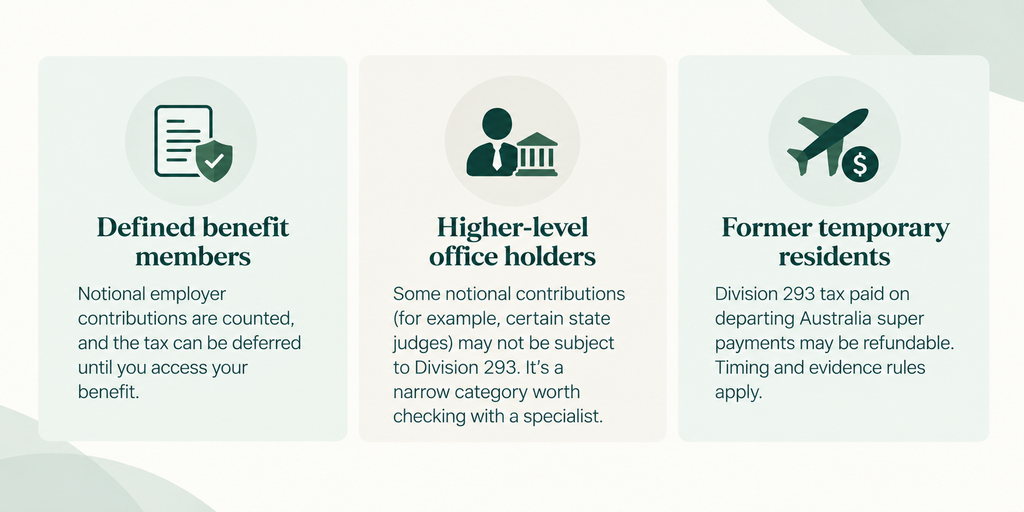
Defined benefit members: Notional (rather than actual) employer contributions are counted for Division 293 purposes, calculated by the fund actuary. The tax can be deferred against the defined benefit interest and paid when the benefit is accessed.
Higher-level office holders: Some notional contributions for constitutionally protected funds (for example, certain state judges) may not be subject to Division 293. It's a narrow category worth flagging to a specialist if it applies to you.
Former temporary residents: If your super was paid out as a departing Australia superannuation payment, Division 293 tax paid on those contributions may be refundable. Timing and evidence rules apply.
Division 293 Tax FAQs
What is the Division 293 threshold?
The Division 293 threshold is $250,000. It's been at that level since the 2017–18 financial year. From 2012–13 to 2016–17 it was $300,000. If your combined Division 293 income and concessional super contributions cross $250,000, the extra 15% tax applies to the amount that pushed you over, or to your concessional contributions, whichever is less.
How do I know if I have to pay Division 293 tax?
You'll receive a Division 293 assessment from the ATO through myGov or the post, usually six to twelve months after the end of the financial year. The ATO calculates it automatically once your tax return has been lodged and your super fund has reported your contributions. There's nothing you need to trigger.
Is Division 293 tax on top of the 15% contributions tax?
Yes. The standard 15% contributions tax is deducted inside your super fund when the contribution arrives. Division 293 adds another 15% on the affected concessional contributions, giving you a 30% effective rate. It's still lower than the 47% top marginal rate plus Medicare, which is why salary sacrifice usually still works.
Can I pay Division 293 tax from my super?
Yes. You have up to 60 days from the date of the assessment to elect to release the money from your super fund. An APRA-regulated fund then has 30 days to complete the release authority and pay the ATO. You can also pay personally and leave your super balance alone.
Does Division 293 apply to non-concessional contributions?
No. Division 293 only applies to concessional (before-tax) contributions such as employer super guarantee, salary sacrifice and personal deductible contributions. Non-concessional contributions are made from after-tax money and sit outside the Division 293 calculation entirely, though they have their own separate cap rules.
How long do I have to pay a Division 293 assessment?
The due date is shown on the assessment notice from the ATO. You can pay personally by the due date, or elect within 60 days to release the funds from your super to cover it. Missing the due date attracts a general interest charge, so if cash flow is tight, the release authority is usually the safer path. For broader context, see how much super you should have by age.
This article is general information only and does not take your personal circumstances into account. Speak to a registered tax agent or licensed adviser before making decisions about super contributions or tax.
References