
In-House Asset Regime March 2026

Written by:
Published on
Quick Overview

What are in-house investment assets rules? As a Trustee of a Self-managed Superannuation Fund (SMSF) you can invest in any asset, however there are certain restrictions imposed on investing in a business, loans, or assets connected to the trustee and members of the fund. These assets are called in-house assets of the fund. The in-house…

Why choose us
Low Fees in the Market
Affordable setup and ongoing compliance costs — without sacrificing quality.
Dedicated SMSF Specialists
Work directly with experienced Chartered Accountants and SMSF specialsts.
24/7 Local Support
Get help anytime from a fully Australian-owned and Australia-based team.
No Lock-In Contracts
Total flexibility. Stay because you’re happy, not because you’re tied down.
Read more about us
Limited time onlyFREE SMSF
Save over $874
Use Code: FREESMSF
*Terms and Conditions apply, does not include ASIC fee
Start Application

We offer services across

Table of contents

What are in-house investment assets rules?

As a Trustee of a Self-managed Superannuation Fund (SMSF) you can invest in any asset, however there are certain restrictions imposed on investing in a business, loans, or assets connected to the trustee and members of the fund. These assets are called in-house assets of the fund.

The in-house asset rules are designed to make sure your super remains strictly for retirement purposes — not for helping members, relatives, or related entities.

Certain limited related-party investments are permitted as long as they are tightly controlled and within the limits mentioned in the legislation. In this newsletter, we’ll break down in brief, what is in and what is not in an in-house asset rules.

Understanding In- House Assets in an SMSF

An in-house asset of a superannuation fund broadly means:

An asset of the fund, that is:

  • A loan to a related party of the fund;
  • An investment in a related party of the fund;
  • An investment in a related trust of the fund; or
  • An asset of the fund that is subject to a lease or lease arrangement with a related party.

In simple terms, if your SMSF is “investing in or doing business” with someone closely connected to the members or the trustees of the fund, it is likely that the investment to be an in-house asset. And if funds breach the in-house asset rules then the fund’s auditor is obliged to report the breach to the regulator, namely ATO.

Assets that are NOT In–House Assets

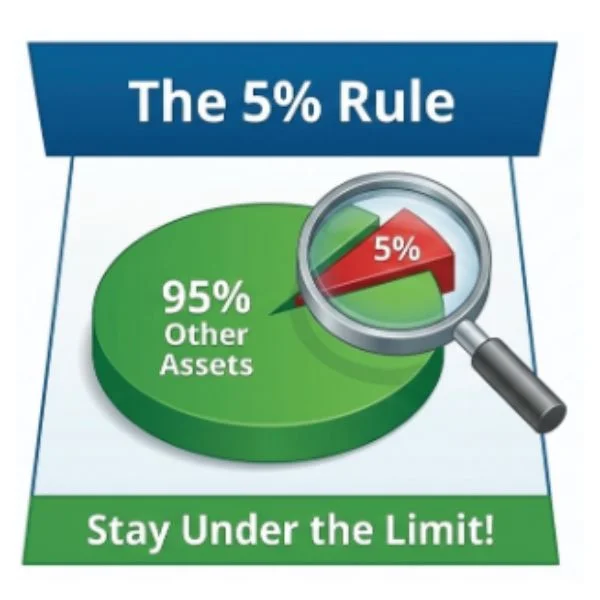
Not every investment connected to a related party will be treated as an in-house asset. The superannuation law also provides specific exclusions — meaning certain assets are automatically not counted, such as investments in in-house asset which are less than 5% of the total market value of all assets of the fund.

There are also some other assets which are not included as an in-house asset, some interesting examples of these assets are:

1.Life Insurance Policies : A life insurance policy issued by a registered life insurance company.

2. Bank Deposits; Money held as a deposit with an ADI (Authorized Deposit-Taking Institution) for example, a bank term deposit.

3. Assets Specifically Approved by the Regulator: If the regulator (usually the ATO for SMSFs) issues:

  • A written notice, or
  • A legislative instrument stating that an asset is not an in-house asset;

4. Business Real Property (e.g. shop, office or factory etc.) Leased to a Related Party: A business real property, and leased to a related party on proper legal terms;

5. Investment in a Widely Held Unit Trust; A widely trust is a fixed unit trust with fixed entitlements to the income & capital of the trust.

Widely held means at least here there are more than 20 entities (Including SMSF) which together at least 75% of units. A special note here is that all related entities are counted only as a single entity.

6. Property Held as Tenants in Common: If a SMSF and a related party jointly own property (as tenants in common), and it is not leased to the related party, it is not an in-house asset (remember no borrowing).

7 . Investment in SISR 13.22C Trusts: There are some special type of trusts which do not borrow and hold assets and only a bank account.

8. Where SMSF invests in a Custodian Trust: These are some special trusts which are created as property custodians when the SMSF borrows aka Bare Trusts.

What is the 5% Rule?

5% exemption investment in in-house assets is sometimes referred to as “5% In-house Asset Rule”. This rule applies to every superannuation fund that is regulated under the law including SMSF’s.
 

How Often is 5% Rule measured?

All SMSF Auditors check the 5% limit of in-house assets at the end of each financial year.

The fund must calculate the market value ratio of its in-house assets (basically, the percentage of the fund’s assets that are loans, investments, or leases with related parties) divided by the market value of all assets of the fund.

If this ratio is more than 5%, then the fund is considered to breach the 5% rule. Then the Trustees must take some action to resolve or to fix this breach.

Action 1: The trustee of the fund must prepare a written plan; This plan must show steps how the trustees propose to reduce the excess amount (above 5% limit)

  • One or more of the funds -inhouse assets held at the of the year are disposed of during the next following year and
  • The value of the assets so disposed of is equal to or more than the excess amount

This plan should be prepared before the end of next year and each Trustee of the fund must ensure that the steps in the plan are carried out.

Certain New In-House Asset Investments Prohibited

This rule applies to SMSF: If in-house assets are already over the 5% limit

  • trustees must not acquire any new in-house assets.
  • In other words, once you’re over the limit, you’re not allowed to add more.

If under the 5% limit

  • If the fund’s in house assets are less than the % limit, trustees must not acquire a new in-house asset if doing so would push the fund over 5% limit.

Hence trustees can only acquire in-house assets if, after the acquisition, the ratio stays at or below 5% of the market value of the funds assets.

What counts as “acquiring”

    • Acquiring an in-house asset doesn’t just mean buying one.
    • It also includes:

      • Making an investment in a related party.
      • Giving a loan to a related party.
      • Entering into a lease or lease arrangement with a related party.

Is lending to a member the same as an in-house asset?

“NO” - A trustee of an SMSF must not lend money of the fund to a member of the fund or a relative of a member of the fund or any other financial assistance using the resources of the fund to a member of the fund or a relative of a member of the fund.

There is a distinction between an in -house asset of a SMSF which is an asset of the fund that is a loan to, or an investment in a related party of the fund, an investment in a related trust of the fund or an asset of the fund subject to a lease or a lease arrangement between trustee of the fund and a related party of the fund

Example

Loan to a Member

Scenario: An SMSF lends $40,000 to a member to help with their personal business. This is not an in-house asset of the fund – this is a direct breach irrespective of the amount lent. Even if $1 is lent to a member or a relative – the fund would breach superannuation law.

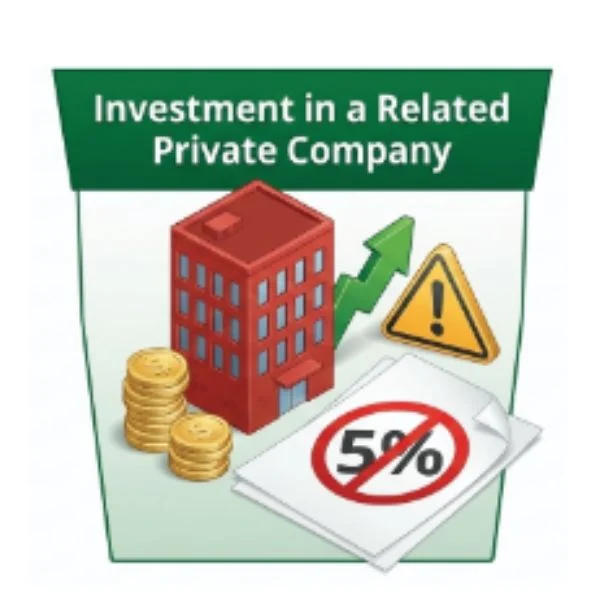
Investment in a Related Private Company

Scenario: A SMSF purchases Units in a trust which has borrowed. If the investment is more than 5% of the funds market value of assets, the fund will breach the 5% rule.

If the trust has no borrowing and is a 13.22C trust, then the SMSF can invest more than 5% - in fact it can even invest 100% of funds cash in this unit trust.
How can we help?

Confusing? Even well-intentioned trustees can unintentionally breach the 5% rule through loans, investments, or lease arrangements with related parties. The consequences can be serious, including rectification plans, auditor contravention reports, and ATO penalties and non-compliancy and the fund losing its concessional status.

Our team is fully committed to ensuring that fund does not breach any superannuation law. If you need help with any of the above, do not hesitate to contact our office.
Paul Altis

Co-Founder / Director - New Venture Wealth
For decades I’ve helped clients build, manage and protect their SMSFs with clarity and confidence. My approach is simple: listen first, explain clearly, and always act in your best interests. When you understand your options, you make better decisions — and that’s where long-term results really come from.
Linkedin

New Venture Wealth are SMSF Specialists and Chartered accountants. We are not financial advisors, and no content on this website should be considered as financial advice. Monthly tax and compliance fees are based on tax and compliance services for SMSF assets. Our monthly tax and compliance fees may vary (we will provide 14 days’ written notice).

*  Free SMSF offer excludes ASIC fees. Must take up first year accounting services on direct debit to qualify for the free SMSF

Subscribe to our newsletter

Subscribe to receive the latest industry insights, stories, and free resources.
1300 050 939Book a Free 15min Call
ASIC Declaration

By ticking this ASIC Declaration box, I / We the above listed office bearers, of the yet to be created company (named above) to the best our knowledge declare that the information provided to Deed Dot Com Dot Au Pty Ltd is True and Correct. By ticking the ASIC Declaration box, I / We request, instruct and authorise on payment of the above fees to Deed Dot Com Dot Au Pty Ltd to apply to ASIC in the prescribed form (Form 201) to create the above named company on the basis of the above information on this page. I / We understand that Deed Dot Com Dot Au Pty Ltd will be lodging this application under ASIC’s Electronic Lodgement Protocol and pre filling Form 201 for electronic Lodgement with ASIC. All Director(s), Shareholder(s), Company Secretary and Public Officer authorise Deed Dot Com Dot Au Pty Ltd to lodge this form and assure and declare that I / we the above listed office bearers have the necessary written & singed consents and agreements referred to in the application from (Form 201) for each person listed above, including consent to act as a Director, Consent to act as a Public Officer, Consent to act as a Secretary, Application for Shares by each shareholder / member.

I / We the above listed office bearers of the yet to be formed company, have had an opportunity to read and understand and take a legal opinion on the constitution of the company which we intend to create and all members / shareholders have agreed to subscribe to this constitution. I / we shall handover the signed consents and agreements as listed above if requested by Deed Dot Com Dot Au Pty Ltd which were signed prior to payment to Deed Dot Com Dot Au Pty Ltd for lodgement of company details in a form (Form 201) to ASIC.

ABR Declaration

I agree that: We(Deed Dot Com Dot Au Pty Ltd) will be sending your information to ATO. They are authorised by taxation laws, including the Income Tax Assessment Act 1936, A New Tax System (Australian Business Number) Act 1999, A New Tax System (Goods and Services Tax) Act 1999 and the Taxation Administration Act 1953 to collect the information requested on this form. ATO need this information to help them administer these Acts and to help them to maintain the details relating to you that are recorded in the Australian Business Register (ABR) and other ATO systems. Where authorised by taxation laws to do so, ATO may give this information to other Commonwealth, State, Territory and local government agencies. Selected ABR information is available to the public. Penalties may be imposed for giving false or misleading information.

SMSF Setup Superfund

We are a firm that provides you with the online tools to create your own self managed super funds. Our firm do not have accountants, financial advisors or legal professionals. Our firm is affiliated with a third party provider who is a firm of accountants and provide us with advice in order to provide you with these online tools and auditing services. DIY SMSF Funds as per law is a financial product. However, none of our products are provided to you as a financial service. We do not provide you with any advice regarding the suitability of any of our SMSF products. You must obtain your own such advice when you obtain a product or service from us. We are affiliated with third party tax agents. DIY Specialist accountants and ASIC approved Self Managed Super Funds auditors. Our firm is not licensed to provide any financial advice about SMSF products and tools.

We follow the best interests of our clients under ASIC’s Regulatory Guide 175.214 and taxation. The only one of the matters that must be considered when making a decision to set up a Self Managed Super Funds. We may at times give some factual information which is not intended to influence you in making a decision. In relation to a particular financial SMSF product or an interest in a particular financial product. This advice should not be considered as particular financial product advice or personal advice. This advice may be given under exemptions contained in Corporate Regulation 7.1.33G. We may refer to you to our third party affiliates. If you require advice relating to SMSF capital giants tax implications of investing in various Asset Classes. If we refer you to any financial planner or advisor. That planner pays us a share of for any financial advice given or commission received for investment in any financial SMSF product. We will advise you in writing before we refer you of our arrangement with the financial advisor.

Election to be a Complying Fund
Declaration

You agree that no principal or any staff member of New Venture Wealth Pty Ltd trading as “New Venture Wealth”:

  • We haven’t offered any financial Self managed super funds product advice or any other professional advice. You must obtain your own such advice before purchasing a Self Managed Super Fund product through us.
  • Didn’t provided you or made a statement of opinion with the intention of influencing you. Our firm has not done any act. Which is intending. It is influencing for me to set up a self managed super funds.
  • We don’t give any financial advice unless in any of the circumstances mentioned in Section 766 A (2) (b) of the corporations Act 2001. Which sets out the circumstances in which our principals or staff members are taken to provide a financial service as an “Eligible Service” defined in Corporations Regulations 7.1.29. These circumstances are that, we provide a financial advices (eligible service) in the course of conducting. What we are allow to do (exempt service). It is reasonably necessary to provide financial advice. This advice is offered as an integral part of our normal accounts functions.
  • Our firm did not provided any financial service as mentioned in Section 766 B to E of the Corporations Act 2001. I have enough opportunities in detail these sections of the Act.
  • Never provided any specific advice on any assets risk policy or specific insurance for any of the asset, the SMSF funds or life insurance policy or the value of insurance required for any member of the self managed super fund.
  • Have not provided any advice regarding transfer of any asset or rollover of any existing superannuation interests in the DIY Self Managed Super Funds. What assets or how much money should contribut to the DIY Self Manage Super Fund. SMSF investment strategies of your DIY Self Managed Super Funds.
  • We did not provided any advice on who should be members and trustees of the DIY Self manage Super Funds. Who should be beneficiaries of any death benefit of any member of the DIY Super Fund.
  • Haven’t provided financial advice on any financial Self Managed Super Funds product other than taxation implications of any financial product. Including establishment, operation structuring or valuation of superannuation fund except for advice. Which is for offered sole purpose. Only to the extent reasonably necessary for the purpose, of ensuring compliance by you with the SIS Act (other than paragraph 52(2)(f)), the SIS Regulations (other than regulation 4.09).
  • We do not provide any advice:
    • relating to the acquisition or disposal by your SMSF of any specific financial products or classes of financial SMSF products
    • a recommendation that you acquire or dispose any superannuation product; and
    • a recommendation in relation to a person’s existing holding in a superannuation product to modify an investment strategy or contribution level.
  • We don’t provide any comparison that your existing superannuation interest with DIY SMSF or any other superannuation product or any investment with another in your DIY SMSF.
  • Didn’t provided any retirement planning or estate planning advice either within or outside of superannuation space or within the ambit of DIY Super Fund.
  • That New Venture Wealth can send me follow up communications and promotions. Which relate to my application process, auditing and other new product and promotional releases.
  • I have obtained my own independent profession advice who holds an Australian Financial Services License (AFSL) and conducted my own research in making a decision to set up a SMSF.
  • I understand that once I set up my own Self Managed Super Funds, I as trustee will be responsible for my superannuation funds and I have read all my administrative functions and duties as a trustee and all investment restrictions as detailed in the ATO trustee declaration form.

I have read, understood and accept the Terms & Conditions of use of this website;
I hereby authorize “Deed Dot Com Dot Au Pty Ltd” to set up a Self Managed Superannuation Fund Trust Deed for the above named trustees;
All above trustees are aware that an ATO declaration must be signed within 21 days of commencing their duties;
I am authorised to complete and lodge this form on behalf of the Trustees with “Deed Dot Com Dot Au Pty Ltd”, Australian Tax Office and Australian Business Register.
I have read, understood and accept the declaration.

By clicking the button below “ Accept all disclaimers and declarations ” . Providing my personal and information of all members of the proposed DIY SMSF on the online form. I am instructing New Venture Wealth Pty Ltd and their principals, partners and staff to provide administrative task. Establishing an SMSF as defined in 17A of SIS Act for me..