

Table of contents
Last updated: September 2026
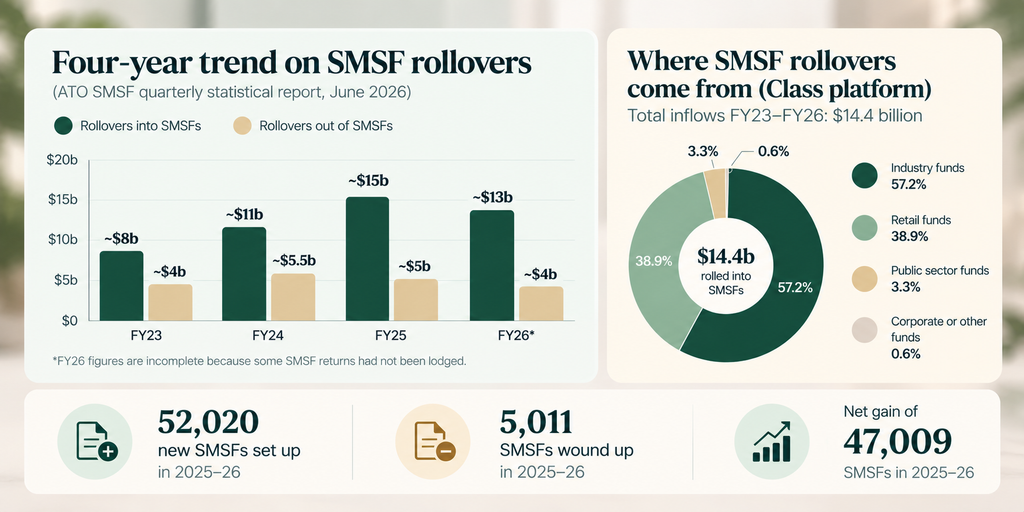
Between FY23 and FY26, $14.4 billion was rolled into SMSFs administered on the Class platform, compared with $5.7 billion rolled out. Industry funds accounted for 57.2% of those inflows. These figures cover SMSFs administered through Class rather than the entire SMSF sector.
This page is for industry fund members trying to work out whether an SMSF genuinely suits them, existing trustees checking whether they made the right call, and anyone who wants the honest version. That includes when staying put is the smarter move.
What the 2026 rollover data actually shows
The Class data shows a sustained four-year pattern rather than a single-year jump. Between FY23 and FY26, $14.4 billion was rolled into SMSFs administered on the platform, compared with $5.7 billion rolled out. Industry funds contributed 57.2% of those inflows, followed by retail funds at 38.9%, public sector funds at 3.3%, and corporate or other funds at 0.6%.
Here's the four-year trend on rollovers in and out of SMSFs, per the ATO's SMSF quarterly statistical report (June 2026). The ATO’s sector-wide estimates are larger because they cover the broader SMSF population:
| Financial year | Rollovers into SMSFs | Rollovers out of SMSFs |
|---|---|---|
| FY23 | ~$8b | ~$4b |
| FY24 | ~$11b | ~$5.5b |
| FY25 | ~$15b | ~$5b |
| FY26* | ~$13b | ~$4b |
*FY26 figures are incomplete because some SMSF returns had not been lodged.
Establishments tell the same story. In 2025–26 there were 52,020 new SMSFs set up against 5,011 exits, a net gain of 47,009. Whatever the market noise, more Australians are opening SMSFs than closing them, year after year.
What an industry super fund is, and what an SMSF is
An industry super fund is a large, APRA-regulated superannuation fund that pools members’ money at scale. The fund's professional managers make the investment decisions, run the administration, arrange group insurance and handle compliance. You pick a risk option or sit in the MySuper default.
An SMSF is a private super fund with up to six members, where the members are also the trustees. You choose the investments, keep the records, arrange the audit and lodge the annual return. The ATO regulates SMSFs, not APRA, and the trustees carry the legal responsibility for every decision the fund makes. If you want the mechanics in more detail, we've covered how a self-managed super fund works in a separate guide. Short version of the regulator split: APRA supervises large funds that manage other people's money, the ATO supervises funds where the members are the trustees.
SMSF vs industry super fund, side by side
| Attribute | SMSF | Industry super fund |
|---|---|---|
| Control | Trustees make investment and administration decisions within the governing rules. | Fund decides, you pick a risk option |
| Investment choice | Broad: direct shares, property, gold, crypto, term deposits, managed funds | Menu of pre-built options plus limited direct share windows |
| Fee structure | Usually includes accounting, audit and administration costs, plus investment, transaction and advice costs where relevant | Usually includes administration and investment fees, which may be fixed, balance-based or a combination |
| How fees scale | Fixed compliance costs may become a smaller percentage as the balance grows, but total costs depend on the investments and fund structure | Costs depend on the fund, investment option and applicable fee caps |
| Insurance | Arranged separately, individually underwritten | Group cover, often automatic acceptance |
| Admin burden | Trustee holds records and coordinates providers | Handled by the fund |
| Compliance and audit | Independent audit and annual return required | Fund's responsibility |
| Tax timing | Trustee chooses when to realise gains | Fund manager decides across the pool |
| Regulator | ATO | APRA |
In pooled industry fund options, investment and tax decisions are generally made at fund level. SMSF trustees have more control over when assets are sold, but the tax outcome depends on whether the assets support retirement-phase income streams, how exempt current pension income is calculated and the member’s transfer balance cap. Moving into pension phase does not automatically make every capital gain tax-free.
Why more Australians are switching from industry funds to SMSFs
Common reasons members consider an SMSF include:
Greater control over how the money is invested. You choose the assets, the weightings, the entry and exit points. Nothing happens in the fund without a trustee decision behind it.
A lack of flexibility in industry funds. The menu is the menu. If you want direct exposure to a specific property, a concentrated stock position, or an asset class your fund doesn't offer, an industry fund may not offer it or may impose limits.
Wanting to be more involved in managing wealth. Some people are happy for a fund manager to run the money. Others want to see the portfolio, understand the decisions and make the calls themselves. That preference doesn't fade with age. For a lot of members it grows.
Approaching retirement and needing tailored decisions. As you get closer to drawing a pension, the timing of asset sales, the cash buffer you hold and the way income is generated all start to matter more. An SMSF lets you shape those decisions around your actual retirement date, not a fund-wide average.
Access to a broader range of permitted investments. Direct residential and commercial property, direct Australian and international shares, physical gold, cryptocurrency, private trusts. These assets can be held through an SMSF where the investment complies with the fund’s strategy, the sole purpose test and the rules governing related parties, ownership, custody and borrowing.
Investment choice: what an SMSF opens up
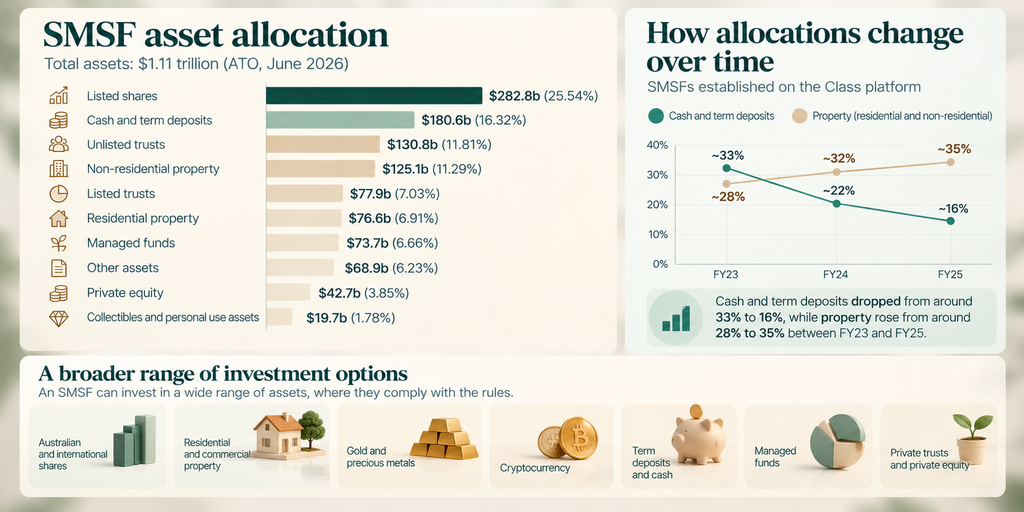
The ATO's June 2026 data shows where SMSF trustees are actually putting the money. Listed shares are the single biggest allocation at $282.8 billion, or 25.54% of total SMSF assets. Cash and term deposits sit second at $180.6 billion, or 16.32%. Unlisted trusts, non-residential property and listed trusts fill out the next tier. The full breakdown of asset classes available to a self-managed super fund shows how those options fit together.
Allocations also shift as a fund matures. Looking at SMSFs established on the Class platform in FY23, cash and term deposits dropped from around 33% of assets to around 16% by FY25, while property rose from around 28% to 35%. One possible explanation is that newer funds hold more cash initially and invest it progressively.
Different investments bring different ownership, custody and compliance requirements. Our guides explain the specific rules for SMSF property, direct shares in an SMSF, gold in an SMSF and SMSF crypto .
For an industry fund member used to a default balanced option, the shift is real.
SMSFs aren't just for pre-retirees anymore
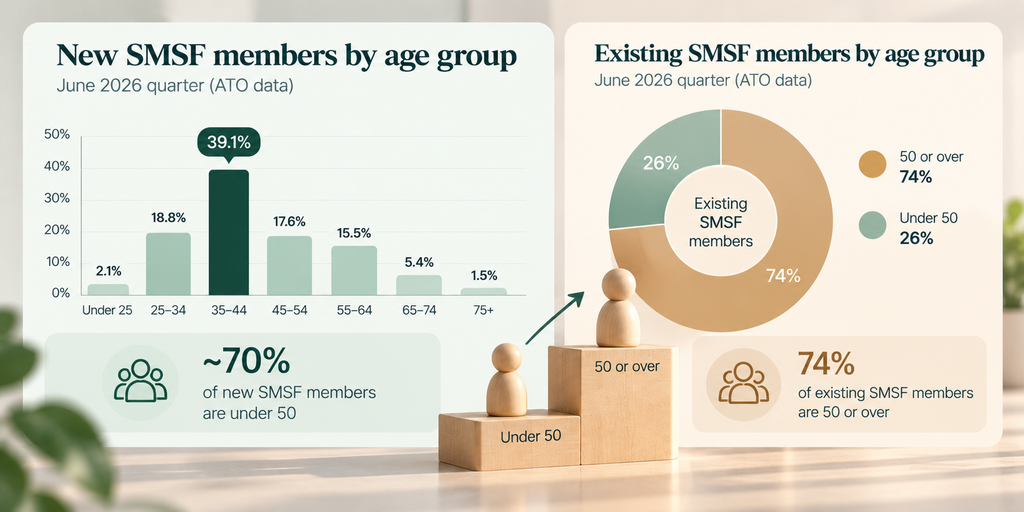
The 35 to 44 age bracket accounted for 39.1% of new SMSF members in the June 2026 quarter, per the ATO. Around 70% of new SMSF members are under 50. Set that against the existing SMSF population, where 74% of members are 50 or over, and the shift becomes obvious.
What's actually behind that change matters. Class data also points to continued residential property borrowing within its client base. However, the age figures alone do not show how younger members invest or whether they use leverage. Anyone entering an SMSF to hold one major asset still needs to consider concentration, liquidity, debt servicing, diversification and insurance.
If you are under 50 and considering an SMSF for one major asset, the concentration, liquidity and insurance risks deserve particular attention.
When staying in an industry fund is the smarter call
Lower balances. The fixed cost base of running an SMSF (accounting, audit, ASIC where relevant) doesn't scale down. If your balance is modest, those costs will eat a bigger percentage of returns than the equivalent industry fund fee. The maths only starts working meaningfully once the balance can absorb them.
You don't want the workload. Trustees hold legal responsibility for the fund. Even with an accountant handling the paperwork, you're signing the annual return, approving the investment strategy and making the calls. If that feels like a burden rather than an opportunity, an industry fund is doing exactly what you want it to do.
You may lose insurance attached to your industry fund account. Many super funds provide life and TPD cover automatically, often without medical checks, although eligibility, premiums and cover conditions vary. Before closing an account or rolling over the full balance, confirm when the existing cover ends and whether replacement cover is available. Keep the existing cover in force until any replacement policy has been formally accepted.
The honest costs and what you take on as trustee
Costs vary between providers and fund structures, but they usually fall into the following categories:
- Setup costs for the trust deed, corporate trustee if used, and ATO registrations. Our SMSF set-up costs breakdown has the current numbers.
- Annual accounting. Preparation of financial statements, member reports and the annual return. The guide on SMSF accounting costs covers what's reasonable and what isn't.
- Independent audit. Every SMSF is audited every year by an approved SMSF auditor. Our overview of SMSF audit requirements explains what auditors look at and where trustees get caught out.
- ASIC fees if you use a corporate trustee. See the current SMSF ASIC fees for the annual figure.
Beyond costs, you're taking on legal duties. Trustees must set and review an investment strategy, keep records for the statutory period, meet the sole purpose test on every decision, and lodge the SMSF annual return on time. The practical rhythm of running an SMSF day to day sits alongside those obligations.
What happens when SMSFs are wound up
Some SMSFs are wound up because the structure no longer suits the members. Some people set up an SMSF, run it for a few years, and decide it isn't for them.
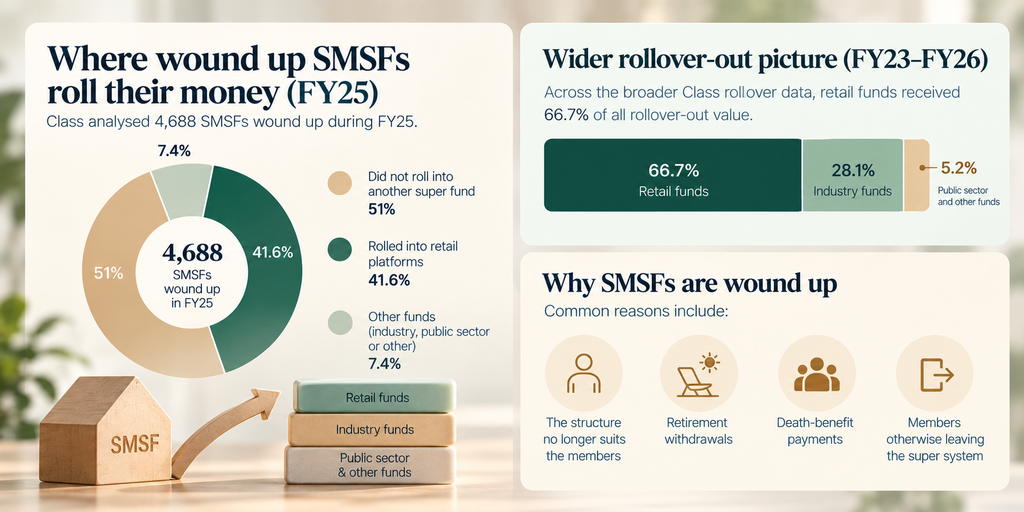
Class analysed 4,688 SMSFs wound up during FY25. More than half, 51%, did not roll money into another super fund, which may reflect retirement withdrawals, death-benefit payments or members otherwise leaving the super system. Among the funds that did transfer assets, retail platforms accounted for 41.6% of wind-up rollovers.
Across the broader FY23 to FY26 Class rollover data, retail funds received 66.7% of all rollover-out value. That broader figure should be kept separate from the wind-up analysis.
Can you have an SMSF and an industry fund at the same time?
Yes. There's no rule that says you can only be a member of one super fund at a time, and running an SMSF alongside an industry fund is common.
Some members retain an industry fund account to preserve existing group insurance while using an SMSF for other assets. This only works if the account continues to meet the fund’s balance, contribution, inactivity and premium requirements. Confirm those conditions directly with the fund before relying on this arrangement.
If you decide to make the move
The short version of the steps: establish the SMSF and appoint trustees, get the trust deed and ATO registrations done, open the fund's bank account, sort replacement insurance if needed, then initiate the rollover from your existing fund. Our SMSF set up guide walks through each step in order.
Common timing problems include starting the rollover before replacement insurance is approved, failing to plan for an illiquid balance and overlooking the electronic service address requirement. Our post on SMSF set-up mistakes covers the ones we see repeatedly.
Frequently asked questions
Self managed super funds vs industry funds, the short version?
Industry funds are professionally managed, APRA-regulated and low-effort. SMSFs are self-directed, ATO-regulated and put every decision and every legal responsibility in the trustee's hands. The trade-off is control against workload.
SMSF vs retail fund, how do they differ?
Retail funds are also APRA-regulated and professionally managed, but tend to offer wider investment menus than industry funds and are usually run by for-profit providers. Compared with an SMSF, members generally cannot choose to hold direct property themselves. Any access to crypto or related products depends on the investment options offered by the retail fund.
SMSF vs industry super performance, which does better?
The returns aren't directly comparable. MySuper returns are reported for particular products or lifecycle stages under APRA’s reporting framework. SMSF returns depend entirely on the trustee's asset mix, which varies enormously from fund to fund, and are calculated on a different fee base. Comparing a published MySuper return to an SMSF return is comparing two different things.
Can an SMSF invest in an industry fund?
Not in the usual sense. An SMSF can't hold units in a member's personal industry fund account. It can invest in APRA-regulated pooled products where those are structured as available to trustees, but this is uncommon and rarely the reason someone sets up an SMSF.
APRA fund or SMSF, which regulator covers what?
APRA supervises funds where a trustee manages other people's retirement money, which covers industry, retail, corporate and public sector funds. The ATO supervises SMSFs, where the members are the trustees. Different regulators, different rulebooks, different levels of protection.
Is there government compensation available if something goes wrong?
APRA-regulated funds have access to a government financial assistance scheme in defined circumstances involving fraud or theft. SMSFs are not covered by that scheme. Trustees carry the risk themselves, which is another reason the compliance and audit requirements matter.
Working out which one suits you
If you want a hands-off arrangement, group insurance you already qualify for, and a balance where percentage fees still work in your favour, an industry fund is probably doing the job. If you want direct control, specific assets your current fund can't hold, and the tax timing discretion that comes with running your own fund, an SMSF is worth costing out properly.
Our SMSF pricing is published so you can see the numbers before you book anything. Our SMSF accountants can explain the establishment, administration and tax costs during a free consult. Personal advice about whether an SMSF suits your circumstances should come from a licensed financial adviser, particularly where insurance, investments or retirement strategy are involved.
General advice disclaimer: The information on this page is general in nature and does not take into account your personal financial situation, needs or objectives. New Venture Wealth are registered tax agents and SMSF specialists, not licensed financial advisers. Before acting on any of the information above, consider whether it is appropriate for your circumstances and seek personal advice where relevant.
References