

Table of contents
Last reviewed: September, 2026
Next review: after 1 July 2027, when 2027-28 figures are released by the ATO.
Applies to financial year: 1 July 2026 to 30 June 2027
For 2026-27, the concessional super contributions cap is $32,500 and the non-concessional cap is $130,000. Every figure on this page has been checked against the ATO and gets refreshed each 1 July.
This is the numbers page. If you want the concepts behind concessional and non-concessional contributions, the concessional vs non-concessional contributions guide covers that separately. Here you get the current caps, the bring-forward tiers, the carry-forward rule, total super balance thresholds, excess contributions tax and Division 293. Nothing more.
Quick refresher. Concessional contributions are the pre-tax ones: employer super guarantee, salary sacrifice and personal deductible contributions. Non-concessional contributions are after-tax money you put in from your own pocket.
2026-27 super contribution caps at a glance
| Cap or threshold | 2026-27 amount |
|---|---|
| Concessional contributions cap | $32,500 |
| Non-concessional contributions cap | $130,000 |
| Bring-forward maximum (3 years) | $390,000 |
| Carry-forward eligibility TSB threshold | Under $500,000 |
| Non-concessional cut-off TSB | $2.1 million |
| Division 293 income threshold | $250,000 |
Source: ATO key superannuation rates and thresholds.
Concessional contributions cap for 2026-27
The general concessional contributions cap is $32,500 for all individuals, applying from 1 July 2026. Same figure regardless of age or income.
What counts toward it:
- Employer super guarantee payments
- Salary sacrifice contributions
- Personal contributions you claim a tax deduction for
Concessional contributions are taxed at 15% inside your fund. That's the trade-off for the pre-tax entry. Go over the cap and the excess is handled differently, which we cover further down.
Carry-forward concessional contributions: the 5-year rule
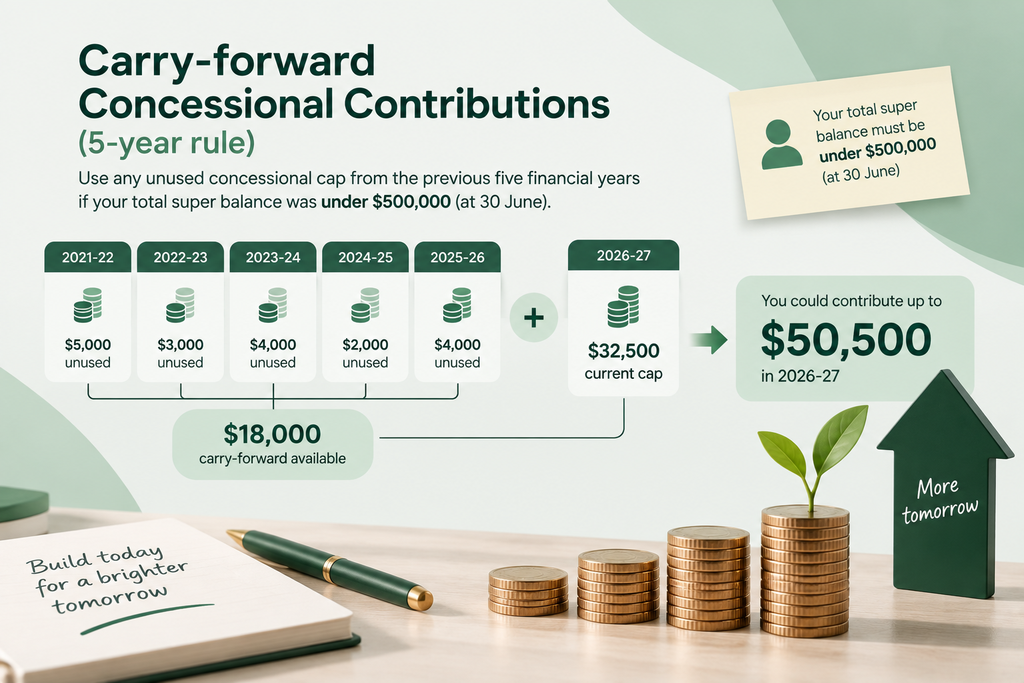
You can carry forward unused concessional cap amounts from the previous five financial years, but only if your total super balance was under $500,000 at 30 June of the previous financial year. Unused amounts expire after five years.
Quick example. You've got $18,000 of unused concessional cap accumulated across the last few years, and your TSB at 30 June 2026 was $410,000. In 2026-27 you can contribute up to $50,500 on the concessional side. That's your $32,500 current cap plus the $18,000 you've carried forward.
Once you cross the $500,000 TSB line, carry-forward is off the table for that year. It can come back if your balance drops below the threshold again in a later year.
Non-concessional contributions cap for 2026-27
The non-concessional contributions cap for 2026-27 is $130,000. That's four times the concessional cap.
Non-concessional contributions are after-tax money. You've already paid income tax on it, so there's no 15% contributions tax on the way in.
Access to the cap is gated by your total super balance. If your TSB at 30 June 2026 was $2.1 million or more, your non-concessional cap for 2026-27 is nil. Contribute anything and it's excess.
Bring-forward rule: 2026-27 thresholds and limits
The bring-forward rule allows eligible people who are under 75 at any time during the financial year to access up to three years of non-concessional contribution caps. What you can bring forward depends on your total super balance at 30 June 2026.
| TSB at 30 June 2026 | Bring-forward cap | Period |
|---|---|---|
| Less than $1.84 million | Up to $390,000 | 3 years |
| $1.84 million to less than $1.97 million | Up to $260,000 | 2 years |
| $1.97 million to less than $2.1 million | $130,000 | Standard cap only, no bring-forward |
| $2.1 million or more | Nil | No ordinary non-concessional contributions under this cap |
Source: ATO non-concessional contributions cap.
Total super balance thresholds that affect your caps
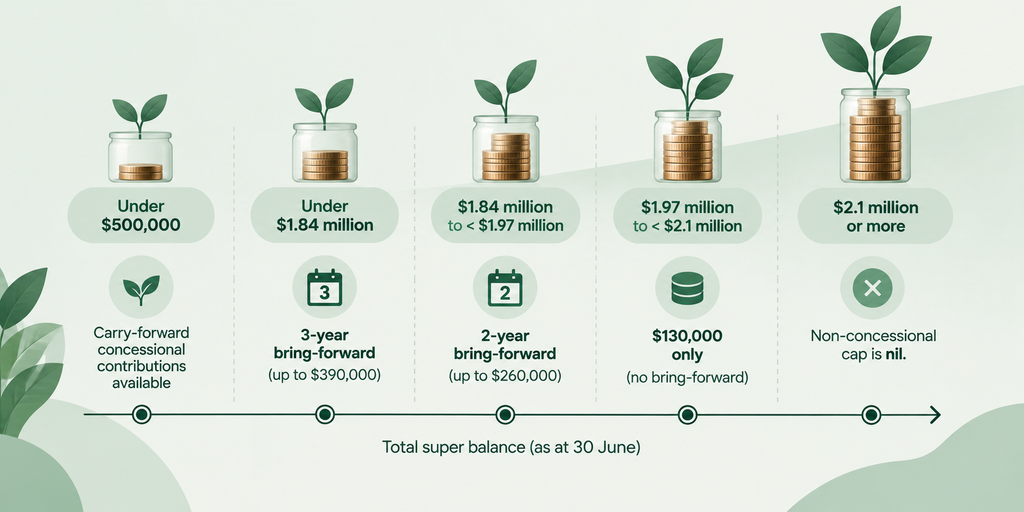
Total super balance is measured on 30 June, and it decides which caps you can use in the following year. Every TSB threshold on this page in one place:
- Under $500,000: you can use carry-forward concessional contributions
- Under $1.84 million: full three-year bring-forward available ($390,000)
- $1.84m to under $1.97m: two-year bring-forward ($260,000)
- $1.97m to under $2.1m: standard $130,000 non-concessional cap, no bring-forward
- $2.1 million or more: non-concessional cap is nil
Curious where your balance sits against the pack? Our super balance by age benchmark gives you a rough read.
Excess contributions tax: what happens if you go over the cap
Excess concessional and excess non-concessional contributions are handled differently.
Excess concessional contributions are added to your assessable income and taxed at your marginal rate, with a 15% tax offset to recognise the contributions tax already paid by the fund. You can elect to release up to 85% of the excess from your fund to help pay the additional tax. The separate excess concessional contributions charge no longer applies to excess contributions made from 1 July 2021.
Excess non-concessional contributions give you a choice. You can release the excess plus 85% of the associated earnings, with the earnings taxed at your marginal rate. Or you leave it in, and the excess is taxed at the top marginal rate of 47%. Most people release.
You won't have to guess whether you've gone over. The ATO issues a determination once your fund's contribution data is reported, then a release authority follows if you elect to release.
Division 293 tax: the extra 15% for high earners
Division 293 tax applies where your Division 293 income plus concessional super contributions exceeds $250,000. The tax is 15% of the excess over the threshold, or 15% of your taxable super contributions, whichever is less.
The ATO calculates it after you lodge your tax return and your fund reports your contributions. You get a separate notice of assessment for Division 293 and can pay it personally or release the amount from super.
Planning contributions inside an SMSF
Contribution timing requires particular care inside an SMSF. A contribution generally counts when the fund receives it, and trustees must allocate it to the correct member’s account within the required timeframe. A payment received after 30 June may count towards the following financial year, potentially affecting the member’s available cap or total super balance position.
If you'd like a hand mapping these caps to your fund's strategy, including the ongoing work of running an SMSF, we offer a free consultation. Book a free consultation.
How the 2026 super tax changes interact with these caps
Broader super tax changes came into effect in 2026, and they sit alongside the caps on this page rather than replacing them. The caps still work the same way. What's shifted is the treatment of balances above certain thresholds.
For the full picture on the 2026 super tax rule changes for SMSFs, we've covered the detail separately.
Super contribution caps: frequently asked questions
What is the concessional contributions cap for 2026-27?
The concessional contributions cap for 2026-27 is $32,500 for all individuals, applying from 1 July 2026. It covers employer super guarantee, salary sacrifice and personal deductible contributions combined. Contributions inside the cap are taxed at 15% in your fund.
What is the non-concessional contributions cap for 2026-27?
The non-concessional contributions cap for 2026-27 is $130,000, which is four times the concessional cap. Non-concessional contributions are after-tax money, so no contributions tax applies on the way in. Your cap drops to nil if your total super balance was $2.1 million or more at 30 June 2026.
Can I carry forward unused concessional contributions?
Yes, if your total super balance was under $500,000 at 30 June of the previous financial year. You can carry forward unused concessional cap from up to five previous financial years, and unused amounts expire after five years. This is often called catch-up concessional contributions.
How does the bring-forward rule work?
The bring-forward rule lets eligible people under 75 use up to three years of non-concessional cap in a single year. For 2026-27, someone with a TSB under $1.84 million can contribute up to $390,000 over three years. Higher TSB tiers reduce the bring-forward amount, and $2.1 million or more means nil.
What is the total super balance threshold for non-concessional contributions?
The total super balance cut-off for non-concessional contributions in 2026-27 is $2.1 million, measured at 30 June 2026. Above that, your cap is nil. Between $1.97 million and $2.1 million you get the standard $130,000 cap with no bring-forward. A re-contribution strategy can be worth considering here.
What happens if I exceed the super contribution cap?
Excess concessional contributions are added to your assessable income and taxed at your marginal rate, with a 15% offset for tax already paid in the fund, plus an excess charge. Excess non-concessional contributions can be released with associated earnings taxed at your marginal rate, or left in and taxed at 47%.
Who pays Division 293 tax?
You pay Division 293 tax if your Division 293 income plus concessional super contributions exceeds $250,000 in a financial year. The tax is an additional 15% on the excess over the threshold, or 15% of your taxable super contributions, whichever is less. The ATO issues a separate assessment.
References