

Table of contents
Comparing gold with shares is useful only when the purpose of each investment is clear. Shares can generate dividends and participate in business growth, while gold is generally held for diversification and protection against certain market and currency risks. If you're weighing gold vs stocks for the next contribution into your fund, the honest answer isn't a winner. It's a decision about what each one is meant to do inside your strategy, and what changes when you actually have to hold, store and account for either of them. This post covers the returns, the income, the volatility, the buying methods, the compliance layer most comparisons skip, and how to decide. Silver, platinum and diamonds are out of scope.
Gold vs Shares: The Returns, Side by Side
Numbers first. Here's how the ASX 200 total return index stacks up against gold over the periods people actually search for.
| Period | S&P/ASX 200 Accumulation (XJOAI) | Gold / Perth Mint Gold (PMGOLD) |
|---|---|---|
| 1 year | 4.40% | 18.42% |
| 3 years (p.a.) | 11.24% | 27.19% |
| 5 years (p.a.) | 7.81% | 19.95% |
| 10 years (p.a.) | n/a | 15.20% (PMGOLD to 31 Mar 2026) |
| 20 years (p.a.) | 7.55% | 10.74% (USD terms) |
Source: ASX Investment Products Report, period ending 31 August 2026, for the 1, 3 and 5 year figures. Perth Mint Gold fact sheet to 31 March 2026 for the 10-year annualised. Livewire Long Term Investing Report 2025 for the 20-year figures, covering FY2005/06 to FY2024/25.
There are two qualifications worth making before drawing a conclusion from the table. The ASX figures show total returns with dividends reinvested, so comparing them with a price-only share index would understate the performance of shares. The Livewire 20-year gold figure is in USD, while the shorter PMGOLD figures reflect an unhedged Australian-dollar investment. Currency movements can materially change the return received by an Australian investor, so these figures should not be treated as a perfectly like-for-like comparison.
Gold has had a strong run. Over 20 years it beat the ASX 200 on the numbers above. It also had long flat stretches where shares compounded quietly in the background.
Income: Shares Pay You, Gold Doesn't
This is where the argument for shares stops being close. The ASX 200 pays a distribution yield on top of price growth, and for Australian residents franking credits lift the effective yield further. Gold pays 0.00%. The PMGOLD fact sheet lists a historical distribution yield of exactly zero, because a bar of metal doesn't generate cash flow.
That lack of income is part of the trade-off. Investors generally hold gold for capital preservation or diversification rather than regular cash flow. For a fund in the pension phase, however, the distinction has practical consequences. Gold may need to be sold to meet pension payments, while dividends can provide cash without requiring the fund to dispose of shares.
Reinvested dividends are also why every honest long-run return figure for equities uses the accumulation index, not the price index. If you're comparing gold vs the share market on a price chart, you're comparing gold to a version of shares that's had its income stripped out.
Volatility and What Each One Does When Markets Fall
Higher long-run returns from shares come with deeper drawdowns. That's the deal. Equity markets fall 20% or more on a rough schedule, and the recovery is what compounds. Gold behaves differently. It tends to move independently of shares, and in stressed markets it often moves the other way. That's the whole point of holding it.
Call it a hedge, an inflation store, a portfolio insurance policy. The framing changes but the function doesn't. Gold isn't there to outrun shares over 30 years. It's there to hold ground when shares are losing it, and to protect purchasing power when inflation eats into cash.
Shares are the engine. Gold is the shock absorber. Confusing the roles is where most portfolio arguments go wrong.
Physical Gold, Gold ETPs and Gold Miners Are Three Different Things
Most comparison posts treat these as interchangeable. They aren't.
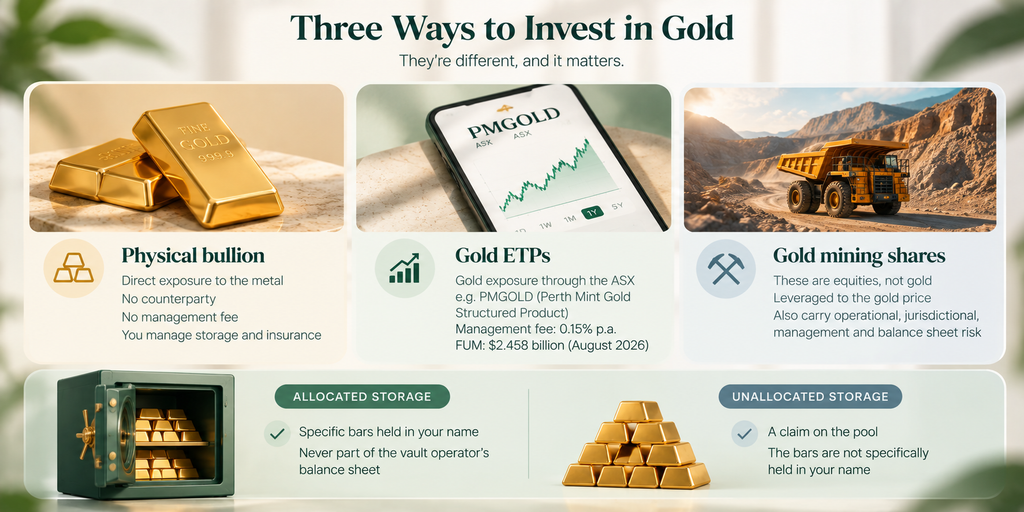
Physical bullion. Direct exposure to the metal, no counterparty, no management fee. You carry the storage and insurance job yourself.
Gold ETPs. Products in this category are often described broadly as gold ETFs, but PMGOLD is technically a Perth Mint Gold Structured Product. It provides gold exposure through the ASX with a management fee of 0.15% p.a. and FUM of $2.458 billion as of August 2026.
Gold mining shares. These are equities, not gold. A miner's share price is leveraged to the gold price, but it also carries operational risk, jurisdictional risk, management risk and balance sheet risk. A miner can still fall when gold rises if production costs increase, a project is delayed or management performs poorly. Its return therefore reflects both the gold price and the risks of operating a company.
Storage matters too. Allocated storage means specific bars are held in your name and never form part of the vault operator's balance sheet. Unallocated is a claim on the pool. The distinction matters if the counterparty ever gets into trouble.
What Changes When You Hold Either One Inside an SMSF
Inside an SMSF, the comparison extends beyond investment performance because the administration and compliance requirements differ by asset type.
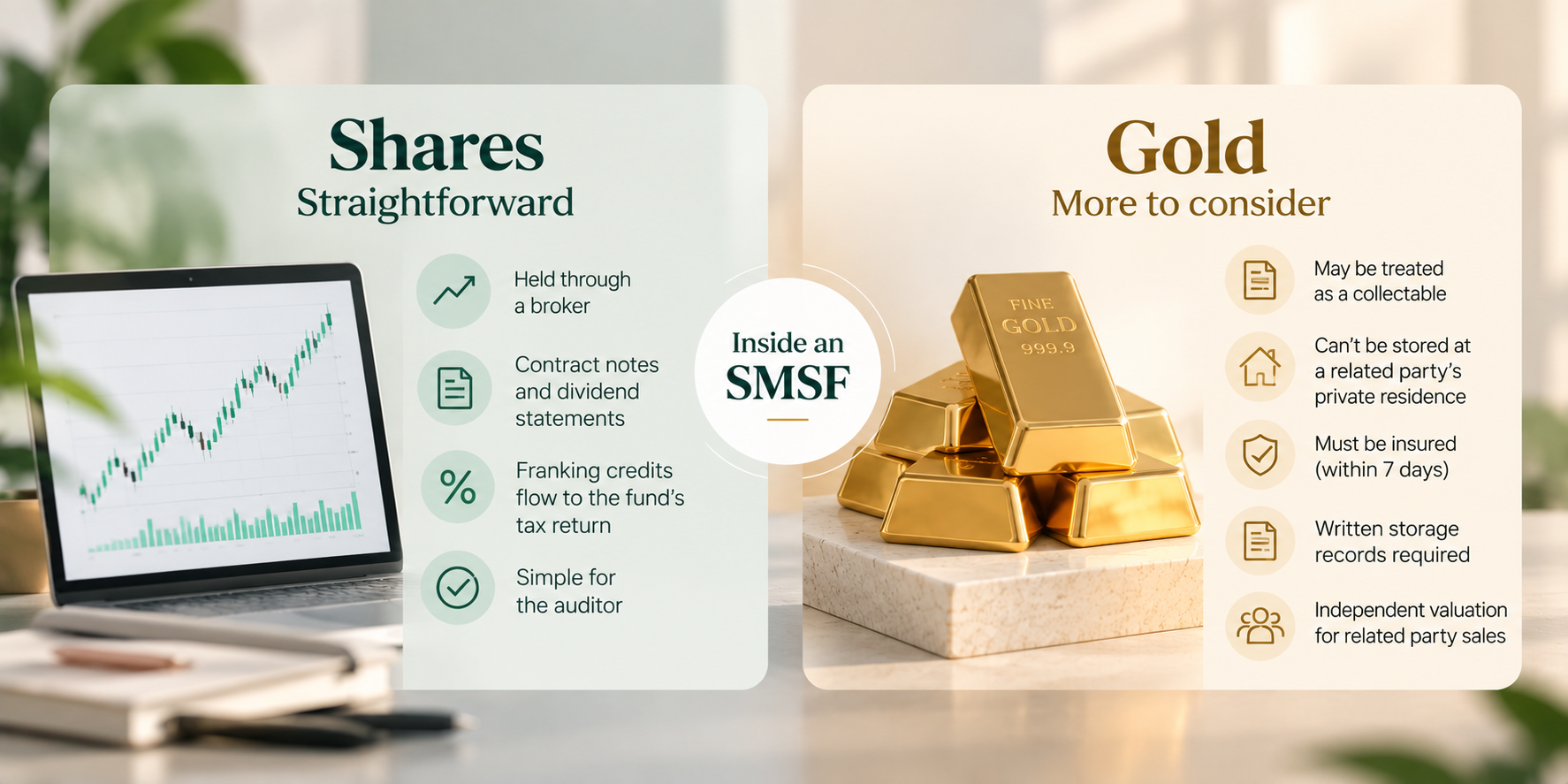
Shares in a fund are straightforward. Custody through a broker, contract notes, dividend statements, franking credits flow to the fund's tax return. The auditor sees a holding statement and moves on.
Bullion is not. Bullion held for its metal value is an investment asset. Coins and medallions may fall within the collectables and personal use asset rules, including coins whose market value exceeds their face value. Whether a particular bullion product is caught depends on its legal form and characteristics, so trustees should confirm the classification before deciding how it will be stored and insured.
Under those rules, the collectable can't be used by or leased to a related party, can't be stored or displayed in a related party's private residence, needs a written record of the storage decision, must be insured within seven days of acquisition with the fund listed as owner and beneficiary, and can only be sold to a related party at a market value set by a qualified independent valuer. SIS Regulation 13.18AA prescribes a penalty of 10 penalty units for these offences. From 1 July 2026, one Commonwealth penalty unit is $364, making the prescribed amount $3,640 for each trustee who commits an offence. The consequences will depend on the particular contravention and the number of trustees involved.
Holding bullion in a fund is administratively different to holding shares, which is why SMSF gold sits as its own service line. The auditor will need evidence establishing what the fund owns, where it is stored and how it has been valued. For assets caught by the collectables rules, that evidence also includes the written storage decision and insurance in the fund’s name. Missing records can create an audit issue and, depending on the breach, may lead to a qualified audit report.
Home safes are where trustees come unstuck. A trustee's private residence is not compliant storage for coins caught by the collectables rules, full stop.
Liquidity: What It Actually Costs to Sell
ASX shares currently settle on a T+2 basis. Orders can generally be executed during the trading day, with settlement occurring two business days later. Brokerage and bid-ask spreads vary by broker and security, although heavily traded ASX 200 shares generally have relatively narrow spreads.
Gold ETPs such as PMGOLD trade on the ASX with same-day execution. The 0.15% MER is the ongoing cost. Selling looks like selling any other listed security.
Physical bullion is slower and more expensive. Dealers quote a spread between buy and sell, and if the bar's provenance isn't obvious an assay may be required. Stored bars need to be shipped or delivered, which means logistics and insurance. For a fund paying a pension, that matters. You can't sell a bar on Tuesday to pay a pension on Wednesday without planning ahead.
Where Property Sits in the Same Decision
Property comes up in the same conversation. Over the 20 years to FY2024/25, Livewire has Australian investment property at 9.16% p.a., sitting between gold and shares on total return but with a completely different liquidity, tax and gearing profile. It's not a substitute for either. Held inside a fund, SMSF property is its own decision with its own rules around limited recourse borrowing, single acquirable asset tests and related-party leasing.
A detailed comparison with property would require a separate analysis.
What About the Dow, the S&P 500 and the FTSE?
The long-run Dow vs gold comparison is the one most global media runs. Over long enough windows the two swap leadership repeatedly, and the Dow's total return once dividends are reinvested is stronger than the price chart alone suggests. Same logic as the ASX.
The FTSE 100 has been a weaker performer than either US or Australian equities over the past decade, which flatters gold in a UK-focused comparison. For an Australian trustee though, the ASX 200 is the right benchmark. It's the index your fund is most likely holding, taxed under Australian rules, paying franked dividends into an Australian tax return.
So, Gold or Shares? How to Decide
The allocation should reflect what the fund needs from each asset. Dividend-paying shares may help meet pension obligations and support long-term growth, while a measured gold allocation may provide diversification and some protection against inflation or equity-market stress. Neither benefit is guaranteed, and the balance will vary between funds.
The right allocation is a conversation with your adviser, not a percentage pulled off a blog. Anyone giving you a specific number without seeing your fund's balance, member ages, contribution pattern and risk tolerance is guessing.
New Venture Wealth administers both asset classes inside SMSFs across Melbourne, Perth, Canberra, Brisbane and Sydney. The share side of a fund's investment strategy is handled through our SMSF equities and shares service, and the bullion side runs through the gold service linked above.
If you're weighing where the next contribution goes, book a free consultation and we'll walk through your fund's current position.
*This article is general information only and does not take your personal circumstances into account. It is not personal financial or tax advice. Speak to a licensed adviser before making an investment decision.*
FAQs
Can I invest my super in gold?
Yes, through an SMSF. Retail and industry funds generally don't offer direct bullion. An SMSF can hold physical gold bullion, gold ETFs like PMGOLD, or gold mining shares, provided the investment fits the fund's written investment strategy and complies with SIS Act rules on storage, insurance and related-party use.
Is gold safer than cash?
Over long periods, yes, if safety means preserving purchasing power. Livewire has cash returning 3.03% p.a. over 20 years to FY2024/25, barely ahead of inflation. Gold returned 10.74% p.a. in USD terms over the same period. Short term, gold is more volatile than cash. Long term, cash loses to inflation.
Can my SMSF store gold at home?
Bullion that is not legally classified as a collectable is not subject to the specific prohibition on storage at a related party’s private residence. Even then, the trustees must be able to establish the fund’s ownership, keep the asset separate from personal property and satisfy the fund’s investment, valuation, security and audit requirements. Coins and bullion coins that fall under the collectables rules cannot be stored or displayed in a related party's private residence, per the ATO. This is a common breach point and the sort of item covered in the SMSF audit requirements an auditor will test.
Is gold or shares better in an SMSF?
Neither wins outright. Shares produce income the fund can use to pay pensions or reinvest, and franking credits lift the after-tax return. Gold hedges equity drawdowns and inflation but pays nothing. An SMSF may hold both where the allocation fits its investment strategy, liquidity requirements and members’ circumstances.
Are gold ETFs treated the same as physical bullion?
No. An exchange-traded gold product such as PMGOLD is a listed security, held through a broker with a holding statement, and reported like any other share. Physical bullion sits under the fund's investment or collectables rules depending on the form, with separate storage, insurance and valuation obligations.
How do gold vs stocks compare over the long term?
Over 20 years to FY2024/25, gold returned 10.74% p.a. in USD terms against the ASX 200 at 7.55% p.a. total return. Gold led on price, shares led on income. Different windows produce different answers, which is why holding both, sized to purpose, tends to beat betting on one.
Related Reading
- SMSF vs industry super fund comparison
- SMSF accounting, taxation and auditing service
References
- ASX Investment Products Report, August 2026
- Perth Mint Gold Structured Product fact sheet, March 2026
- Livewire: The best performing asset classes over 20 years