

Table of contents
Are you up to date with the latest SMSF changes?
Dear Trustees,
With SMSF Annual Return lodgment season underway, this is a busy time in the compliance calendar. We have still taken the time to update you on what is happening in the SMSF space.
Are you across the latest developments? If so, great. If not, we're here to help.
In this edition, we cover:
- Why the ATO is increasing its focus on SMSF asset valuations?
- The ATO's clarification on SMSF set-up costs.
- What a recent Tribunal decision shows about withdrawing super before meeting a condition of release?
- The Government’s ban on new SMSF borrowing to buy residential property from 10 August 2026.
Let’s take a closer look at these key developments and what they mean for you as an SMSF trustee.
ATO increases its focus on SMSF asset valuations as the new tax on super balances over $3 million begins
As an SMSF trustee, you should know that the ATO is increasing its focus on SMSF asset valuations, as the new Division 296 tax on large super balances.
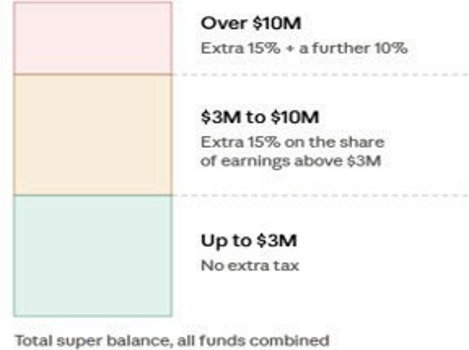
What is Division 296, in simple terms? It is not a cap. There is no limit on how much you can hold in super. Instead, if your total super balance (across all your super funds) is more than
$3 million, an extra 15% tax applies to the share of your earnings that relates to the part of your balance above $3 million. If your balance is more than $10 million, a further 10% applies to the share above $10 million.
Why valuations matter: Your total super balance depends on the market value of your fund’s assets. For
2026–27, the ATO uses your balance at the end of the year (30 June 2027) to decide whether the extra tax applies or not. If an asset such as a property is valued too low, your balance could be wrong, and so could your tax.
Under Regulation 8.02B of the Superannuation Industry (Supervision) Regulations 1994 (SISR), SMSF assets must be valued at market value when preparing the fund’s financial statements.
The ATO is also watching SMSF auditors closely. During 2025–26, it completed close to 200 reviews and audits of SMSF auditors and referred 39 auditors to the Australian Securities and Investments Commission (ASIC). For 2026–27, expect your auditor to ask for stronger valuation evidence this year.
How we can help: Our office can assist you with obtaining appropriate valuations and supporting documentation to help ensure your SMSF assets are valued at market value.
SMSF establishment costs clarified by ATO
The general rules around SMSF establishment costs were already in place, but the ATO had not clearly explained on its website how these establishment costs should be treated when a member/trustee pays personally. The updated guidance now makes this clearer:
- A member can pay the establishment costs personally and seek reimbursement from the SMSF as soon as the fund has cash available.
- Paid before the SMSF legally exists: this is not a contribution, whether or not the fund later reimburses the member, because the fund did not exist when the payment was made.
- Paid after the SMSF is established and reimbursed: this is not a contribution, because the fund’s capital does not increase.
- Paid after the SMSF is established and not reimbursed: the amount must be treated as a contribution to the fund, which counts towards the member’s contribution caps.
- The establishment cost is a capital expense of the fund and is not deductible.
So, the ATO has not necessarily introduced a new rule; it has provided clearer guidance.
How we can help: Our office will assist you in correctly recording your fund's establishment costs in the financial statements.
Tribunal decision shows the dangers of withdrawing super early
The Administrative Review Tribunal has highlighted the serious tax consequences that can arise when superannuation is accessed before a valid condition of release is met. The case is Santavas and Commissioner of Taxation [2025] ARTA 2515.
What happened?
- A couple lost money when their builder went into liquidation midway through a townhouse development.
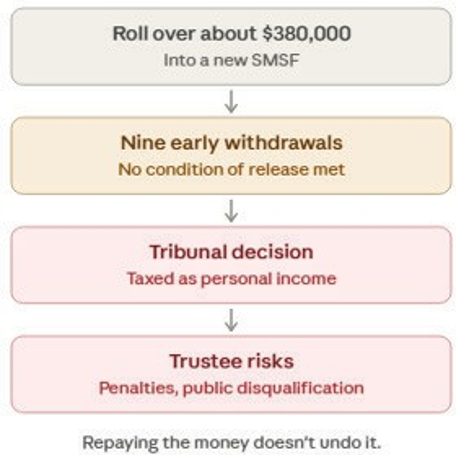
- On a tax agent's suggestion, they rolled over about
$380,000 into a new SMSF and withdrew it in nine transactions to fund the project.
- They hadn't retired or met a condition of release, so the withdrawals were illegal.
- No SMSF tax returns were lodged, and the withdrawals weren't reported in their own returns.
What the Tribunal decided
- The Tribunal refused to use its discretion to stop the withdrawals being taxed, because the couple themselves chose to take the money out.
- Their argument that they relied on their tax agent's advice failed. There was no written advice, and an article they were given said super funds can't provide non-retirement benefits.
- The withdrawals were taxed as part of their personal income. However, the Tribunal cancelled (remitted) the penalties in full.
What this means for you: The ATO says any super accessed illegally is taxed as income, even if it is later paid back, and it cannot be put back into the fund. Trustees who release money to a member who has not met a condition of release may face administrative penalties and can be disqualified as trustees, and a disqualification is made public.
How we can help: Before you withdraw, lend or invest fund money, contact our office and we will help you check the rules first.
Government stops new SMSF borrowing to buy residential property
From 10 August 2026, any limited recourse borrowing arrangement (LRBA – the special type of loan an SMSF can use to buy an asset) entered into to acquire real property can only be used to acquire business real property, which is broadly land and buildings used wholly and exclusively in one or more businesses.
What is not affected? The new rule does not apply to:
- Existing LRBAs entered into before 10 August 2026.
- Refinancing of those existing LRBAs.
- A binding contract to buy property that was exchanged before 10 August 2026, even if the contract settles or the loan is set up after that date.
SMSFR 2009/1 is the ATO ruling that explains the meaning of business real property for the purposes of the Superannuation Industry (Supervision) Act 1993 (SIS Act).
What business real property means in plain English
- Used for a business: The property must be used in a genuine business, such as a factory, warehouse, shop or office.
- Wholly and exclusively: The whole property must be used for business, not partly for business and partly for something else.
- Residential property doesn't qualify: A house or unit bought as a rental investment is generally not business real property.
- Farms: Land used in a primary production business (such as a farm) can still qualify even if there is a home on it, as long as the home is on no more than 2 hectares and the property is mainly used for the business, not for private purposes.
- Rented to a business: Many SMSFs buy commercial premises and lease them to a business.
How we can help: Our office will help you identify whether a property qualifies as business real property, before you sign a contract or arrange a loan.
How can we help?
Our SMSF team is committed to helping you keep your fund compliant with superannuation laws. If you need assistance with any of the matters outlined above, please do not hesitate to contact our office.
General information only: This newsletter is general information and does not take into account your personal circumstances. Please contact our office before acting on anything in it.